This is one of the fundamental types of Pranayam. However, while describing the other eight types of Kumbhakas, this has not been included by the Hathapradeepikakars. But this has been described independently under a Nadishuddhi procedure known as "Samanu". It is necessary to have Nadi Shuddhi before performing Pranayam. Nadi Shuddhi is done with two methods. "Samanu" is performed with Nadi Shuddhi Pranayam with Beej Mantra. Nirmanu is performed through the medium of Dhouti Kriyas.
Of course, the study of Pranayam must start with such basic procedures, so that it becomes easier to study the different types of Pranayams. With this in mind, we will study this Nadi Shuddhi Pranayam first.
It is necessary to sit in Padmasan for practice of Pranayam. The pose should be "Samkayshirogreevam" that means, the spinal cord must be absolutely erect, neck straight, gaze should be firmly centered in front and then the eyes should be closed.
Without affecting the straight posture of the cord, loosen the body, by reducing the strain in the muscles. Pay attention to the breath.
The mind should be concentrated on the air that gradually moves in and out of the nostrils. The tip of the nose will start feeling the touch of the air. The mind should be concentrated on that touch. Do not try to control the breathing, it should be completely natural. The breathing will become gradual on its own, then try to control it gradually. Pooraka and Rechaka should be prolonged and gradual. Try to count the time measure for Pooraka and Rechaka and try to have them in the ratio of 1 : 2. In that pose, continue deep breathing in the same ratio ( 1 : 2 ) Then gradually try deep Pooraka with only the left nostril. After the deep Pooraka, keeping both the nostrils closed, fix Jalandhar Bandh, Mul Bandh and Uddiyan Bandh. Kumbhaka should be of the same duration as that of Pooraka. Then release Uddiyan Bandh, Mul Bandh and Jalandhar Bandh in that order and keeping the left nostril closed, perform Rechaka with the right nostril for exactly double period. This completes half the duration of Nadi Shuddhi Pranayam.
Immediately with the same right nostril, perform deep Pooraka. Keeping both the nostrils closed, perform Kumbhaka and fix all the three bandhas. When the Kumbhaka is of the same duration as that of Pooraka, releasing all the three bandhas, perform Rechaka gradually with the left nostril. This completes the rest half of one cycle of Nadi Shuddhi Pranayam. Immediately, start Pooraka with the left nostril and begin the second cycle of Pranayam. In the initial stages, the ratio of 1 : 1 : 2 ( i e Pooraka 1, Kumbhaka 1 and Rechaka 2 ) is useful. We have learnt deep breathing in the ratio 1 : 0 : 2 , hence here only 1 measure of Kumbhaka ( pranayam ) is introduced. The measure is to be gradually increased to the ideal ratio of 1 : 4 : 2.
If one second is regarded as a unit, then the Pooraka should be for 4 units, Kumbhaka for 16 and Rechaka for 8. This means total 28 seconds for half a cycle. One complete rotation will take 56 seconds i e approximately 1 minute. However, this does not mean that the duration of a minute is fixed for Nadi Shuddhi Pranayam. It should be possible to go through a number of rotations at the rate of one per minute. When the rotations continue, the time measure can go on changing. Sometimes, the control over the breathing is lost, sometimes it is continued on its own. At times, it may turn out to be suffocating and the practice may have to be discontinued for breathing in a natural manner. These are the hindrances in the study of Pranayama. The study of Pranayama means the ability to practice without encountering such hindrances. However, it is advisable to stop the practice when such hindrances occur. There should be no unnecessary strain on the breathing which proves harmful to the body. The duration for which the pranayama is to be practised is the time for which it can be practised easily without encountering any disturbances.
Considering the gamut of the syllabus of Yoga Parichay and the abilities of the Sadhaka, it is stated that he should be able to practise pranayam with ease for a period of ten minutes without facing any disturbances in the proportion of 1 : 1 : 2. The progress should be with this aim.
The physical effects of pranayam is a subject involving research, as it has not been researched thoroughly. There are not many sadhakas who study pranayam for a considerable period and hence there are no researchers too. However, this will be discussed in detail in the syllabus of Yoga Praveen. So we will discuss only the effects which are felt outwardly and are reflected visibly.
The first important point is, while practising pranayam in this manner, the Rechaka is completely performed due to the higher time period. Most of the air in the lungs is thrown out and hence, the Pooraka performed afterwards is also complete. While breathing normally, in any cycle of inhalation and exhalation, we take inside approximately 500 cc air and same amount is also exhaled. The study of Pranayama increases the capacity to 4500 cc and with continued studies it may reach up to 5500 cc.
When so much pure air is inhaled into the lungs each cycle, the purification of the blood should be more effective. The movement of the breathing organs is minimised with multifold effects. This process is the interaction between the oxygen and the carbon di oxide. When there is a Kumbhaka after complete Pooraka, the resultant air pressure makes the interaction process more effective. This type of complete breathing process purifies blood in an effective manner. When such purified blood is supplied to all the organs, their efficiency increases in turn increasing the total efficiency of the sadhaka.
This type of Pranayam creates positive and negative air pressures in the lungs and the stomach cavity. This also causes good effects on the internal organs. This is a good subject for further research. All the three processes in Pranayam i e Pooraka, Kumbhaka and Rechaka have good effects on the nervous system and the brain.
We have seen above that one primary cycle of Nadi Shuddhi Pranayam is of one minute duration. If we count the period of normal breathing, there are 16 to 18 cycles per minute. That means to live for a minute, we have to undertake 16 to 18 cycles. With Pranayam, we live for a minute with only one cycle. This means that we live with minimum efforts. If pranayam is practised continuosly, it can be said that we will be in the habit to live with minimum efforts thereby increasing our life span.
The effect of the strain and pressure caused by the asanas reaches the internal organs only after considerable practice. However, pranayam affects the internal organs directly. To face the effects, the internal organs should have the required capability. This capability is generated through the right practice of asanas. Hence, it is advisable to practise pranayam only after a proper study of asanas for a considerable time period.
Also, certain points as under should be observed carefully :
Even if Pranayam is described in such detail over here, to study it practically, the presence of the Guru is a must. When the practice is started, there are different types of difficulties or doubts. The types differ as per the health of each sadhaka. Only the Guru can solve such problems. Also, the reasons why the different problems arise should be researched so as to eliminate them. Such a guidance is beyond the purview of the book and can be given properly only by the guru.
Note - Hathayoga has stated certain Beejmantras in the Nadi Shuddhi Pranayama. As the topic is included in the syllabus of Yoga Praveen, it is not mentioned here.
Phone - +91-9822770727
E-mail - yoga@yogapoint.com or yogapoint108@gmail.com
Yoga Vidya Dham, Kaivalya Nagari,
College Road, Nashik - 422005.
Maharashtra, India.
Phone - +91-9822770727 (for courses in ENGLISH)
+91-253-2318090 (For courses, in HINDI or MARATHI)
(Please call during 9.00 AM to 5 PM Indian Time)
E-mail - yoga@yogapoint.co or yogapoint108@gmail.com
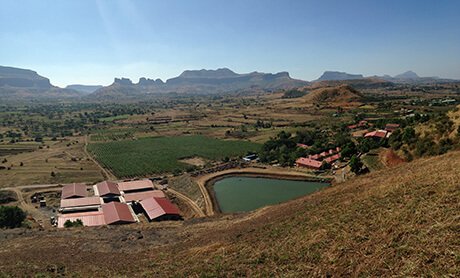
Village Talwade, Trimbak, Nasik
Maharashtra,India.
Phone - +91-9822770727
E-mail - yoga@yogapoint.com or yogapoint108@gmail.com