The word Ujjayi is divided as Ut + Jayi. However, it does not indicate declaration of any type of Jay i e winning. In this type of Pranayama, while performing Pooraka, due to the friction of air in the throat, a typical sound is created. (The sound is different from the sound emitted from the larynx) Hence, the Pranayama is termed as Ujjayi Pranayama. The meaning of the name has not been described anywhere. Instead of wasting time on finding out the meaning, it is beneficial to view the description of the performance.
While studying Nadi Shuddhi Pranayama, we have reviewed in detail how the Pooraka, Kumbhaka and Rechaka should be performed and the conditions or certain things to be remembered while performing Pranayama. All these are necessarily observed while performing this type of Pranayama too. Wherever any change is expected, that only is outlined without reiterating the earlier descriptions.
Poorak performed in a typical manner is the characteristics of this type of Pranayama. The Pooraka is to be performed with both the nostrils. While performing Pooraka, a sound is generated when the air passes through the throat due to its friction. This sound should be consistent from the beginning of the Pooraka till its end. The chest should expand while performing the Pooraka. The stomach should not be contracted while expanding the chest. A control over the muscles of the stomach is to be exercised, so as to achieve only a little bit of contraction, focusing the entire attention on the expansion of the chest. However, attention should be paid to the fact that while expanding the chest, the stomach also is not expanded. The Pooraka should be done at a constant pace and the sound generated should be low and pleasing to the ear. There should not be any ups and downs in the sound. The sound should come out of the upper part of the throat and not from the upper or front part of the nose. If it is generated through these parts, it may prove to be harmful for the nervous system. While performing Pooraka, the facial muscles should not be stretched. The start and the ending of the Pooraka has to be natural. At the end of the Pooraka, one should not strive to inhale further air by using more strength.
The Kumbhaka is to be performed as described earlier. After Pooraka, both the nostrils should be closed, Jalandhar Bandh should be fixed and the Kumbhaka should be performed. During Kumbhaka, the other two bandhas, Uddiyan Bandh and the Mul Bandh should be fixed. The Kumbhaka should be performed till such time as not to have any strain on the breathing system. Then the bandhas should be released and Rechaka should be performed. The units for which Kumbhaka is to be performed cannot be defined, but it should be performed with ease and capability. If the units for which the Kumbhaka is performed are less, then accordingly the Pooraka and Rechaka can also be adjusted.
In this type, Rechaka is to be performed by left nostril. After completing Kumbhaka, the three bandhas should be released and the left nostril should be opened. Then the chest should be contracted and the Rechaka performed at a constant pace. The pace should be gradual and the Rechaka should be performed without any hurry. During Rechaka too, glottis is to be pressed upwards and a sound should be generated as was stated in Pooraka. Rechaka should be double the time allotted for Pooraka. However, while performing such deep Rechaka, it should be limited to the time, so as to perform the subsequent Pooraka in a neat and controlled manner.
The duration for which Pooraka, Kumbhaka and Rechaka are performed, will change according to the capability of the Sadhaka. Hence, the time or the units are not specified. The duration should be such as can be easily performed. There should be seven continuous cycles in one rotation of Pranayama and thereafter each week, three more cycles should be added. However, according to the capacity of each sadhaka, the duration or the number of cycles may be changed and as such no hard and fast rule can be laid down.
| COURSE | Venue |
Phone - +91-9822770727
E-mail - yoga@yogapoint.com or yogapoint108@gmail.com
Yoga Vidya Dham, Kaivalya Nagari,
College Road, Nashik - 422005.
Maharashtra, India.
Phone - +91-9822770727 (for courses in ENGLISH)
+91-253-2318090 (For courses, in HINDI or MARATHI)
(Please call during 9.00 AM to 5 PM Indian Time)
E-mail - yoga@yogapoint.co or yogapoint108@gmail.com
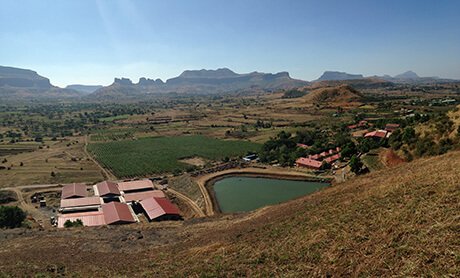
Village Talwade, Trimbak, Nasik
Maharashtra,India.
Phone - +91-9822770727
E-mail - yoga@yogapoint.com or yogapoint108@gmail.com