|
| |
 |
 |
|
| Yoga
Shop |
| |
Books
|
| Asana,
Pranayama, Meditation, Cleansing, Tantra, Patanjali Sutras,
Hatha Yoga, more. |
| |
Audio
Gallery |
| Yoga
Nidra, Meditation, Stress Management, Pranayama, Omkar |
| |
Malas
|
| Rudraksha,
Tulsi, Crystal, Sandal Malas (Rosary for mantras) |
| |
Yantra
|
| Color,
on Copper plate, Crystal Yantras, Shree Yantra, Gayatri Yantra,
Laxmi yantra and more.. |
 |
Contact |
| Download
Demo version |
| |
| Stress
Management Software
(CD / Coprporate Solution) |
|
|
| |
| |
|
| |
Pranayama
- Nadi Shodhan, Anuloma Viloma, Alternate Nostril Breathing
By
- Gandhar
Mandlik (Rishi Dharmachandra) |
|
Print
This Page |
| |
| Send
This Page To Friend |
| |
Anuloma
Viloma (Alternate Nostril breathing) or Nadi Shodhan (Without
Retention or Kumbhaka)
At any time, we only breath through one nostril, left nostril
is active for about 90 minutes, and after that it changes to
right nostril and it remains active for another 90 minutes.
This is a healthy pattern. But due to imbalances in physical
and mental energies, the rhythm is imbalanced. Yoga says that
left nostril is IDA Nadi which represents mental energy and
mind, and right nostril is Pingala Nadi, which represents physical
energy and body. If there is imbalance between Ida and Pingala
then body and mind are imbalanced.
The
purpose of the alternate nostril breathing is to balance these
2 forces, the mental energy and physical energy, to bring harmony
between Body and Mind.
Following
are the benefits of Alternate Nostril Breathing -
- Proper
supply of oxygen is ensured and carbon dioxide is effectively
removed.
- More
oxygen is made available per breath, making the breathing most
efficient.
- Blood
is purified of toxins.
- Very
effective for stress management.
- Helps
reducing the anxiety, depression and other mental illnesses.
- Balancing
Ida and Pingala removes all the blockages in the pranic energy
channels, which may lead to spiritual awakenings.
- It
gives all the benefits of Deep breathing as well.
Practice
- Note (Practice of Anuloma - Viloma or Nadi Shodhan should
be done with a Yoga Expert Only)
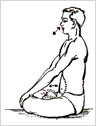
- Begineers
can start with deep breathing practice in sitting position (Padmasana
- Lotus, Swastikasana- Auspicious, Vajrasana - Thunderbolt,
Any Cross legged position in which the body can be relaxed and
spine is erect.)
- Pranav
Mudra of right hand, will help close the right nostril while
inhaling through left nostril and ring finger can close the
left nostril while inhaling through right.
- Initially
4 seconds inhale through left and exhale for 6 seconds through
right nostril, then inhala through right for 4 seconds and exhale
through left for 6 seconds can be practiced for about 5 minutes.
- With
practice one can increase the counts to 4:8, or 5:10 or 6:12
seconds
Precautions
-
- If
you feel little bit of discomfort then you can reduce the ratio
of breathing.
- Under
No circumstances the proportion of the breathing should be forced.
- People
who have undergone abdominal surgeries, heart surgeries, brain
sugeries should consult the medical expert or consultant.
- Please
do not rush to increase the proportions, as it will not help,
but trying to practice easy ratio (4:6 seconds) for little more
time may help.
Initially
one should start slowly by 30 Inhalation and exhalations in
1 minute, and slowly build the speed to 60 rounds in 1 minute.
You may practice it for about 3 minutes.
- After
practicing for 15 to 20 days, one can increase the speed to
about 80 rounds per minute and then you may even do 120 rounds
in 1 minute.
--Gandhar
Mandlik (Rishi Dharmachandra)
References
-
1.
Asana Pranayama Mudra Bandha - Swami Satyananda Saraswati (Bihar
School of Yoga, Munger)
1.
Prana Pranayama Prana Vidya - Swami Niranjananda Saraswati (Bihar
School of Yoga, Munger)
2.
Pranayama - Yogacharya Vishwas Mandlik (Rishi Dharmajyoti),
Yoga Vidya Gurukul, Nasik.
3.
Pranayama - Swami Kuvalayananda (Kaivalyadham, Mumbai)
***********
|
| |
|
|
|
|
Send
This Page To Friend
|
Print
This Page
|
| |
|
|