We are going to discuss about Meditation based on "Pantajali Yoga Sutra (Ashtanga yoga)". In his sutras the "Sage Patanjali" has explained 8 limbs of yoga (Ashtanga yoga). Those are :- Yama, Niyama, Asana, Pranayama, Pratyahara, Dharana, and Dhyan Samadhi. The initial four stage are the basic stages which help the person to attain "Sthiram" (stability of mind) which is the prior necessity for practicing the further stages of meditation. According to him meditation (Dhyan) means -
Now let us see in detail what exactly he means to say about Dhyan(meditation), We all know that our mind is fickle, like a butterfly, which always flies from here and there and does not wait at one place for long. But the speed of our mind is far more than the butterfly or it may be greater than the speed of light.
Mind can recollect past experiences, keeps thinking about the future and experiences the present with all its might and we do not have any control over our minds journey.
'Dhyan'(meditation) is the study of deep concentration, calmness and tranquility of the mind. It is the study of attaining complete control over ones mind. Meditation takes the consciousness beyond conscious, sub conscious & unconscious states to super consciousness.
In the fundamental stages of meditation one has to decide some target upon which one can concentrate. He has to concentrate with the help of his sensors like ' Eyes, Nose, Ears, Mouth and Touch' that means he can
Further more he is not permitted to think anything else, except the target.
A target would be anything, which ones mind would like to concentrate upon. It would be anything, which will give tranquility and serenity to ones mind.
For instance it would be a photograph of ones deity. In this case the photo frame is the target . In the fundamental stage one can look at the frame, the picture of the deity, the background of the picture. Think about all the above factors, recite or hear a mantra of that deity, but one has to see to it that ones mind does not run away beyond the target decided. One can develop his capacity of sitting in this stage from 5-10 minutes to any amount of time.
But once the mind thinks of some other factors your meditation comes to an end . This stage is truly a very fundamental stage and needs a lot of practice because we are never used to control our minds.
Once you have achieved this for specific period of time you can try for the 'Dhyan'.
To explain with Omkar as the target, we have been looking at it, reciting and listening the mantra, our mind stays (appeases) upon it for a specific amount of time.
Now further we close our eyes and recollect the picture of the OM.
At the same time we are reciting or listening to the omkar. Then again with closed eyes we are only hearing the reciting of the mantra on the cassette without reciting by our mouth. Further our minds only recollects the experiences taken by our eyes, ears and mouth. The actual Dhyan stage has only one dimension, now we concentrate on only a part of our target and in the next samadhi stage the person experiencing the target tends to be nobody. Only the experience remains.
At this stage the minds target as a number of dimensions. The mind thinks of all the factors, which it has experienced in the initial stages.
It is very difficult to understand the nature of the mind because it has no physical existence. It is very subtle as well as hidden. But the existence of the mind can't be denied, as many of our problems physical, mental and psychological are the outcome of our mental condition. Mind exists in the body but it is distinct from the body and organs. Mind is also distinct from the spiritual self, 'the Knower' as he just observes the mind and its functions. The Knower perceives the external objects through sense organs but with the help of the mind. Perception of any event is not possible without the presence of mind. So in every event of perception there is an external object, an organ of perception (ears, eyes, nose tongue or skin) and there is mind and the 'Knower' or 'self'. All these are connected very closely, inseparable but still distinct from each other.
The mind can multiply or divide the strength of the Body. The person can't work if he is mentally not prepared for the work but a person can work with extra energy if he has mentally decided to work.
The mind has tremendous speed. It can travel from one point to another point at infinite distance within fraction of a second.
The mind interconnects the 'Self' with the physical body. The mind controls the physical organs through Brain, Autonomous Nervous System, and Endocrine Gland System.
We can summarise seven functions of the mind as follows. Consciousness, Thoughts, Emotions, Perceptions, Memory, Intelligence and Judgment.
You have already seen that
It is clear from the points that the mind is very unstable. Mind doesn't remain stable at any particular point or any object. It keeps moving all the time. Mind runs after the objects it likes but runs away from the objects that it dislikes.
You have already studied that the mind is essential in the process of acquiring knowledge. For example when you are listening to a speaker in lecture, you learn through your ears. But if your mind is not concentrating on the lecture then you won't understand anything there. As the mind is unstable, you cannot concentrate on lecture. So to learn what the speaker is telling, you must establish control over your mind and force it to listen to the lecture. Then only you'll be able to acquire knowledge.
Hence you have to control movements of mind and make it stable whenever you want, as per your requirements. But this is the most difficult part because of unstable nature of mind. This process of making mind stable is called concentration. This is true for any function of mind. If you want to remember a particular event, you will have to concentrate your mind till you remember that event. It is clear from the above discussion that it is essential to control the mind. Only then, one can get what he wants. But controlling mind is the most difficult task. Efforts are being continuously made to find out the ways and means to establish control over mind. Meditation is one of the very effective ways to control the mind. This control can't be achieved in short period. Meditation is a systematically designed technique to achieve this step by step.
You have already studied that the mind is an inseparable part of the human being. It is distinct from brain, nervous system; it is distinct from all other physical organs, it is distinct from Pranic Force behind body activities. The mind is distinct from all these systems but at the same time, it is closely associated with all these systems of the body. Mind is very difficult to access directly but all these systems are relatively easier to access. So mind can be accessed through these systems, we will discuss some of these links.
Introduction
As the name suggests this is a very simple and easy technique of meditation, which can be followed by anyone irrespective of age, sex and physical condition. Even patients can follow this. The result is experience of calm and quite Mind and body.
Important Articles on Meditation -
Phone - +91-9822770727
E-mail - yoga@yogapoint.com or yogapoint108@gmail.com
Yoga Vidya Dham, Kaivalya Nagari,
College Road, Nashik - 422005.
Maharashtra, India.
Phone - +91-9822770727 (for courses in ENGLISH)
+91-253-2318090 (For courses, in HINDI or MARATHI)
(Please call during 9.00 AM to 5 PM Indian Time)
E-mail - yoga@yogapoint.co or yogapoint108@gmail.com
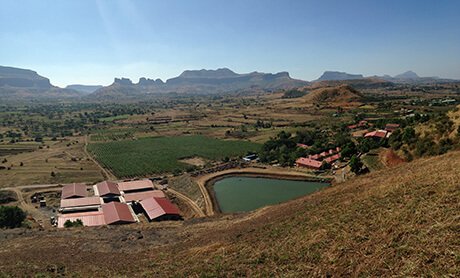
Village Talwade, Trimbak, Nasik
Maharashtra,India.
Phone - +91-9822770727
E-mail - yoga@yogapoint.com or yogapoint108@gmail.com